


DeConTrans
Innovative concepts for a decentralized waterborne container transport
Development of a concept for container distribution in North Rhine-Westphalia using small inland vessels and decentralised transhipment points

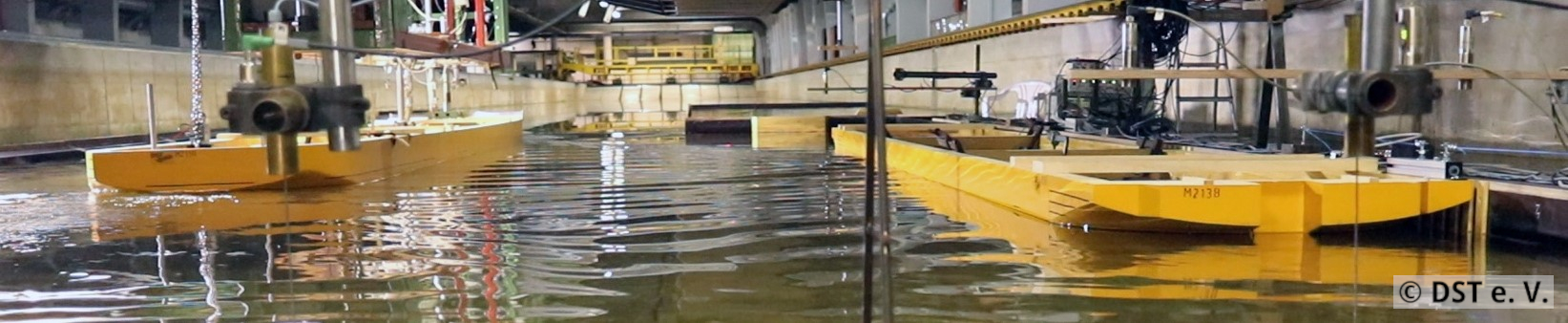
In metropolitan regions such as the Rhine-Ruhr area, the increasing container transport and the associated growth in road freight traffic are pushing the road infrastructure to its limits. The congestion of the roads leads to increased noise pollution and environmental pollution, as well as increased traffic jams. Inland navigation and the German waterways, especially in the western German canal network, offer logistics a considerable amount of unused capacity.
Therefore, an increased use of inland navigation presents itself as a solution to the initial situation. This offers more cost- and energy-efficient transport, but decision-makers are often not sufficiently aware of this fact and so inland navigation is primarily used in the metropolitan areas along the Rhine. The DeConTrans project focuses on the possibilities of container hinterland transport on the West German canal network as a feeder transport to and from the Rhine ports. DeConTrans offers an innovative approach to container transport by inland vessel, building on existing transport concepts and complementing them in a meaningful way. It is a decentralised concept based on small, hybrid-electrically powered vessels, which can also be automated in the future. According to the current project status, the concept can be divided into four interconnected sub-concepts:
Logistics concept: After conducting intensive research and interviews with experts, a total of 105 possible transhipment points and six suitable navigable canals were identified in the western German canal network. The 105 transhipment points include the ports of Dortmund, Hamm, Herne, Münster and Osnabrück, but also suitable port structures of disused coal plants, among others. Destination ports for container transport are Duisburg and Wesel, from where the containers are transported on to the North Sea ports. Complex allocation rules were used to determine which transshipment point receives which freight volume. The transport network thus has a realistic flow of goods. A cost comparison with existing transport concepts that do not use the West German canal system is still pending.
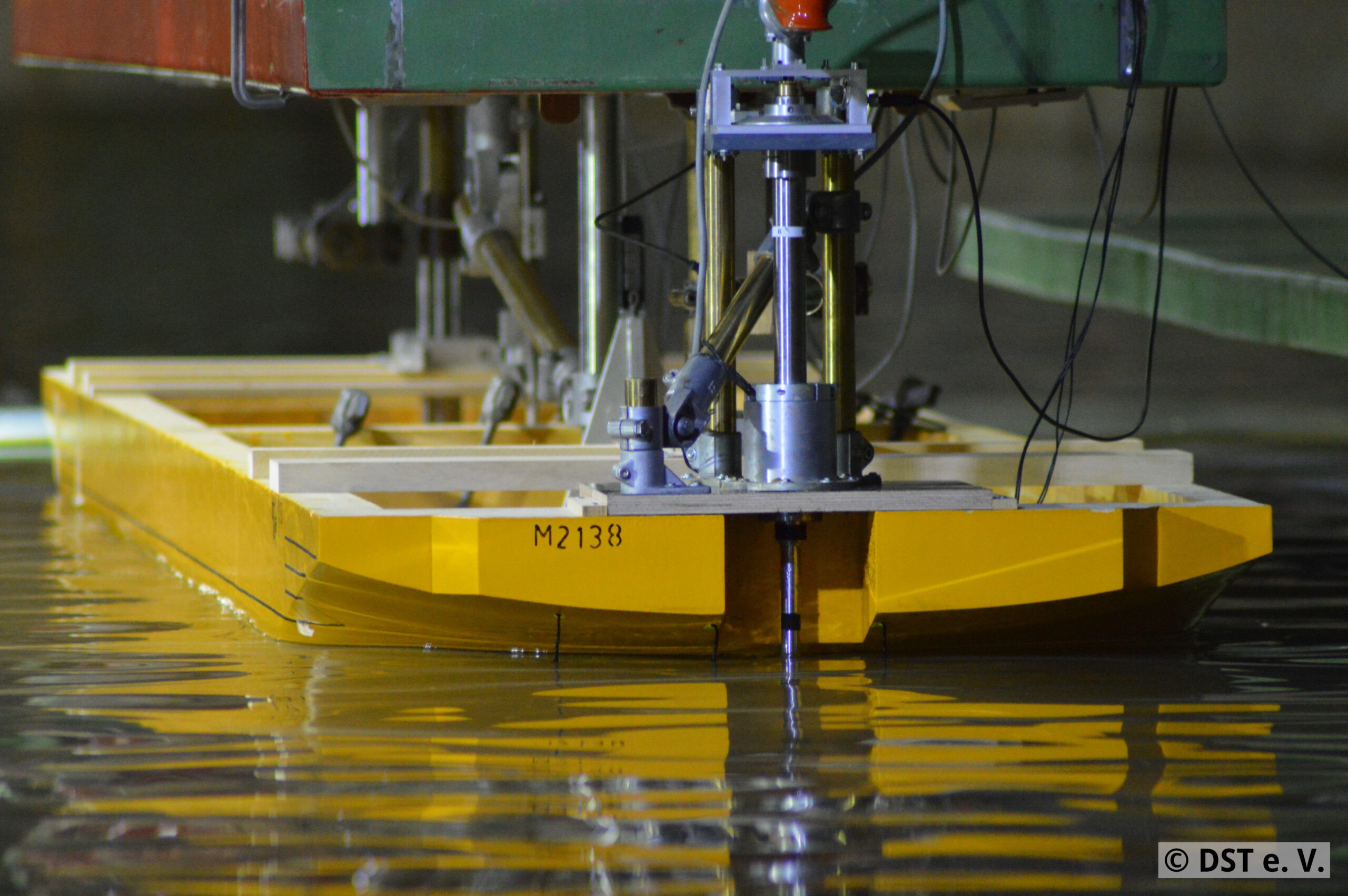
Model tests in the DST test tank.

Model tests in the DST test tank.
Vessel concept: Small ships (8 to 36 TEU) suitable for the canal system are being developed. The transport can be carried out with one or, if necessary, two container layers. The configuration of the ships is adapted to the conditions of the canal system and includes a hybrid electric drive and automatic mooring systems. Scenarios with different staffing schedules are also being examined.
Transshipment concept: If available, the existing container transshipment structure of the transshipment points will be used. Further handling systems, a fixed crane stationed on the ship and a mobile shipboard crane, will be examined for suitability. These are to enable transshipment at transshipment points that do not have active or sufficient structures.
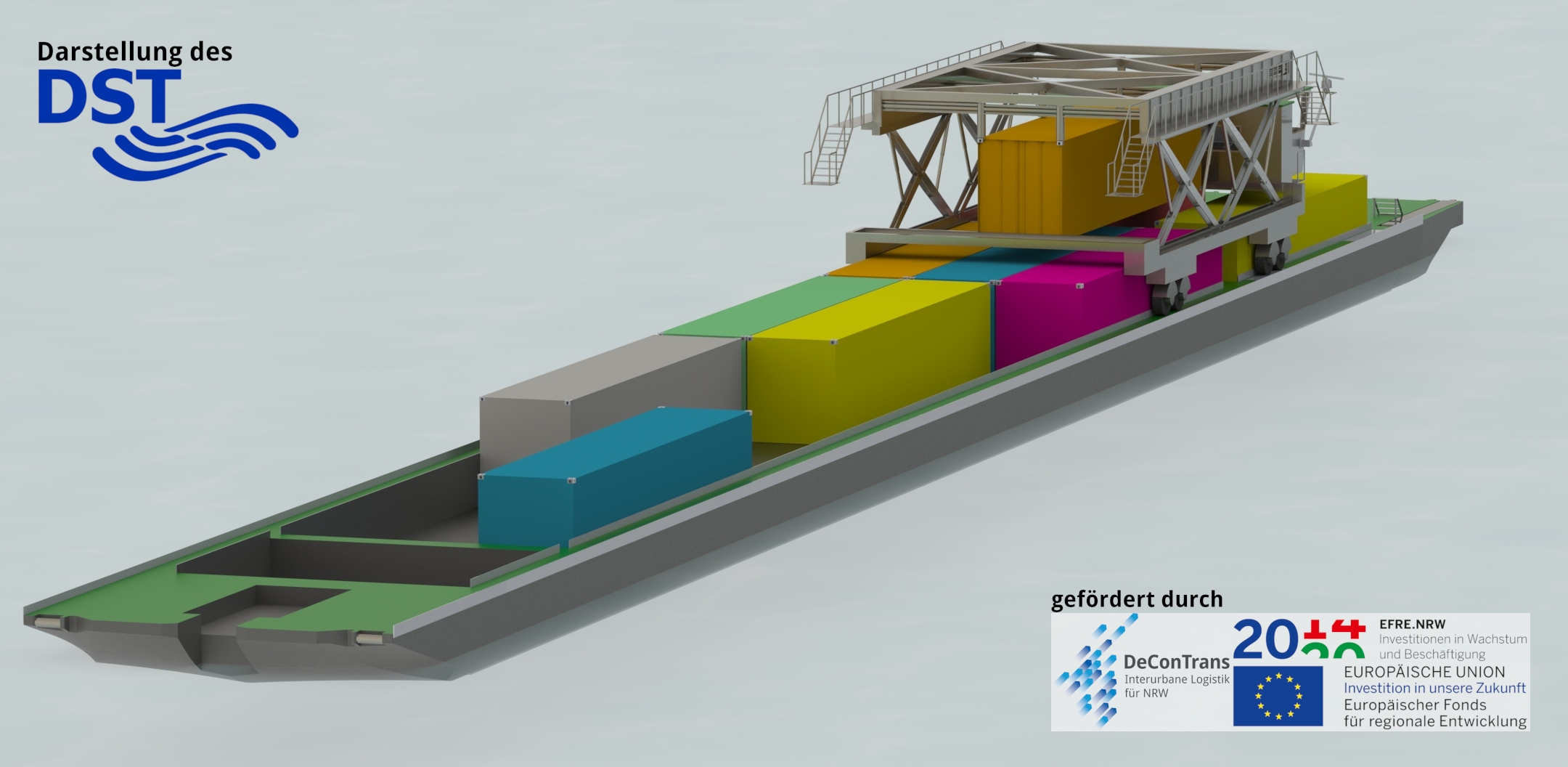
CAD rendering of the on-board crane concept for use in the canal network.
Integration concept: In order to demonstrate the viability of the West German canal system in existing transport and economic structures, a proof of integrability in today’s (global) supply chains will be presented within the framework of DeConTrans, involving all actors involved (ships, transhipment system, trucks). For this purpose, existing IT services and data management applications will be used, which are already successfully in use for existing supply chains.
A simulation environment will be created that prototypically models the relevant system components of the four concepts mentioned and enables the simulation of different scenarios. On the basis of this, an evaluation of different design options will be carried out with the help of predefined criteria, which will form the basis for the choice of the integrated transport system.
Together with the two research projects SPaCiH – SmartPark City Hubs and Virtual Infrastructure and iWALD – Integral World and Local Delivery, DeConTrans forms a consistent process flow of the future in which the goods are brought from the seaports via the waterway to North Rhine-Westphalia and unloaded at the numerous transhipment points in the western German canal network (DeConTrans), where they are fed into various value-added processes, such as sorting or finishing steps, and prepared for further transport (SPaCiH) and then transported in standardised small load carriers to the final recipient in urban distribution (iWALD). For this reason, these three projects have joined together to form a project family in order to align the respective developments with the sister projects and thus ensure future compatibility of the results as well as the feasibility of the process flow.
Overall, the DeConTrans project thus contributes to relieving the burden on the road and rail modes of transport and to the economic utilisation of the domestic waterways and their infrastructure. At the same time, emissions are reduced and sustainable management is made possible.

Welcoming DeltaPort GmbH & Co. KG to the project advisory board.
As part of the online event “Urban supply via waterways” in the ‘JRF on site’ event series, the final event of the research project “DeConTrans – Innovative concepts for a decentralized container transport on the waterway” – with participation of the two JRF member institutes, DST and RIF – took place on 28 March 2022.
In addition to a series of technically related talks from all over Germany, the results of the DeConTrans simulation study could be presented there. Moreover, representatives from the shipping and port industries as well as from politics and research discussed the potentials of city logistics on inland waterways and the conditions necessary for this in a panel discussion.
Project duration:
- October 2018 – March 2022
Funding framework:
- EFRE.NRW Leitmarktwettbewerb „MobilitätLogistik.NRW“, 3. Wettbewerbsrunde
Project coordination:
- Jonas zum Felde, M.Sc.
Dept. Logistics and Transportation
E-Mail: zumfelde@dst-org.de
Tel.: +49 (0) 203 99369-72
Project management:
- Cyril Alias, M.Sc.
Dept. Logistics and Transportation
E-Mail: alias@dst-org.de
Tel.: +49 (0) 203 99369-52
Consortium:
- DST – Development Centre for Ship Technology and Transport Systems
- RIF Institut für Forschung und Transfer e. V.
Associated partners:
- Generaldirektion Wasserstraßen und Schifffahrt (GDWS)
- Konecranes Terex MHPS GmbH
- DeltaPort GmbH & Co. KG
- Eisenbahn- und Hafenbetriebsgesellschaft Region Osnabrück mbH
- Gelsen-Log – Gelsenkirchener Logistik-, Hafen- und Servicegesellschaft mbH
- Hafenband am Mittellandkanal
- MARLO Consultants GmbH
- Mercatronics GmbH
- Mindener Hafen GmbH
- Modal 3 Logistik GmbH
- MSG eG
- MTS Wasseropal GmbH (HTS Group)
- w3logistics AG
Associated projects:
Predecessor projects:
- RuhrCargo (Ziel2.NRW)
Follow-up projects:
Sci. publications:
zum Felde, J. and Alias, C. (2025). Enabling new inland waterway transportation services by means of digital integration. In 2025 IEEE International Conference on Industrial Engineering and Engineering Management (IEEM) (pp. 921–926). Piscataway (NJ), USA: IEEE
DOI – Link
Alias, C., zum Felde, J., Gründer, D., Severin, S., & Alarcón Olalla, F.E. (2023). Assessing the benefits of a decentralized waterborne container transportation service from the perspective of a canal port. In Picado Santos L. de, Pinho de Sousa J., Arsenio E. (Eds.) Transportation Research Procedia: Vol. 72, TRA Lisbon 2022: Conference Proceedings Transport Research Arena (pp. 4444–4451). Amsterdam, Netherlands: Elsevier
DOI – Link
Alias, C., zum Felde, J., Gründer, D., Severin, S., & Alarcón Olalla, F.E. (2023). Evaluating the Effects of a Decentralized Waterborne Container Transportation Service from the Perspective of an Inland Waterway Transport Hub. In Proff, H. (Ed.) Towards the New Normal in Mobility: Technische und betriebswirtschaftliche Aspekte (pp. 811–837). Wiesbaden, Germany: Springer Gabler
DOI – Link
Alias, C., zum Felde, J., & Severin, S. (2023). Examining the Logistics Performance of a Decentralized Waterborne Container Transportation Service in the West German Canal Network with the Help of Discrete-Event Simulation. In Y. Li, Y. Hu, P. Rigo, F. E. Lefler, & G. Zhao (Eds.), Lecture Notes in Civil Engineering: Vol. 264, Proceedings of PIANC Smart Rivers 2022: Green Waterways and Sustainable Navigations (1st ed., pp. 1357–1372). Singapore: Springer Nature
DOI – Link
Alias, C., Gründer, D., Ley, J., Broß, H., Dahlke, L., & zum Felde, J. (2023). Wasserstraßen als urbane Versorgungsadern. In D. H. Schramm (Ed.), UNIKATE – Berichte aus Forschung und Lehre: Vol. 59. Mobilität und Transport im Wandel: Strategie und Umsetzung (pp. 58–71). Essen, Germany: Universität Duisburg-Essen. ISBN: 978–3–934359–59–8
DOI – Link
Alias, C., zum Felde, J., Severin, S., & Alarcón Olalla, F.E. (2022). Measuring the Performance Impact of a Decentralized Waterborne Container Transportation Service on Inland Waterway Hubs in Western Germany. In 2022 IEEE International Conference on Industrial Engineering and Engineering Management (IEEM) (pp. 965–969). Piscataway (NJ), USA: IEEE
DOI – Link
Alias, C. & zum Felde, J. (2022). Evaluating the economic performance of a decentralized waterborne container transportation service using autonomous inland vessels. In 2022 IEEE 25th International Conference on Intelligent Transportation Systems (ITSC) (pp. 3571–3576). Piscataway (NJ), USA: IEEE
DOI – Link
Alias, C., zum Felde, J., Broß, H., and Severin, S. (2022). Evaluating the impact of mobile onboard cranes on the logistics performance of a decentralized waterborne container transportation service. In N. Zrnic, G. Kartnig, & S. Bosnjak (Eds.), XXIV. International Conference on Material Handling, Constructions and Logistics: Proceedings (pp. 161-166). Belgrade, Serbia: Univerzitet u Beogradu, Mašinski Fakultet
Link
zum Felde, J., Alias, C. and Goudz, A. (2022). Comparing generic and dedicated tools of discrete-event simulation for examining inland waterway transportation services. In 2022 IEEE 6th International Conference on Logistics Operations Management (GOL). Piscataway (NJ), USA: IEEE
DOI – Link
Ley, J., Broß, H., & Kämmerling, E. (2022). Experimental Investigation of Passing Ship Effects on Moored Ships in a Canal Port. In M. Candries, E. Lataire, Z. Yuan, K. Eloot, & G. Delefortrie (Eds.), Proceedings of the 6th MASHCON International Conference on Ship Manoeuvring in Shallow and Confined Water – with special focus on port manoeuvres. Glasgow, United Kingdom
Link
Alias, C., Broß, H., zum Felde, J., & Gründer, D. (2021). Enabling Decentralized Transshipment in Waterborne Container Transportation. In C. Jahn, W. Kersten, & C. M. Ringle (Eds.), Proceedings of the Hamburg International Conference of Logistics (HICL): Vol. 32, Adapting to the Future: Maritime and City Logistics in the Context of Digitalization and Sustainability. Pt. 2 (1st ed., pp. 137-166). Berlin, Germany: epubli GmbH
DOI – Link
Alias, C., Pusch, L., Gründer, D., Dahlke, L., Broß, H., Heerwagen, O., & zum Felde, J (2021). Designing a Decentralized Waterborne Container Transportation Service using Small Inland Vessels. In Proff, H. (Ed.), Making Connected Mobility Work: Technische und wirtschaftliche Aspekte (pp. 573–601). Wiesbaden, Germany: Springer Fachmedien Wiesbaden
DOI – Link
Alias, C., Dahlke, L., Heerwagen, O., Gründer, D., zum Felde, J., Pusch, L., & Severin, S. (2020). Identifying Suitable Transshipment Points for a Decentralized Waterborne Container Transportation Network. In 2020 IEEE International Conference on Industrial Engineering and Engineering Management (IEEM) (pp. 799–806). Piscataway (NJ), USA: IEEE
DOI – Link
Alias, C., Gründer, D., Dahlke, L., zum Felde, J., & Pusch, L. (2020). Determining the Freight Volumes for a Decentralized Waterborne Container Transportation Service. In 2020 IEEE International Conference on Industrial Engineering and Engineering Management (IEEM) (pp. 786–793). Piscataway (NJ), USA: IEEE
DOI – Link
Press:
|
This project was funded by the European Regional Development Fund (ERDF) and by the State of North Rhine-Westphalia under grant agreement no. EFRE-0801222 (DeConTrans, AZ: ML-2-1-010A). |
  |